Showing posts with label Vonnegut. Show all posts

Thursday, November 27, 2025

Attack on Titan


For eight years my son and I followed the saga of Erin Yeager in the Japanese anime series “Attack on Titan”.  It is a strange title in that it appears it was either mistranslated or something was lost in translation as there are “attacks” and there are “titans” but there is no “attack on titan” as such.  Before watching it I thought “titan” might be a planet or something.

When we started watching it together my son was 11 and when we finished it he was 19.  With some degree of verisimilitude he was aging at the same rate as the protagonist-turned-antagonist.  I first showed him a scene of an “abnormal” titan running through what looks like an old European city flopping its arms and bouncing off of buildings.  This titan was 45 feet tall and intent on eating any humans it could catch.  It looked like a “normal” adult male but had no clothes and no genitalia, strangely enough.

It confused and fascinated him at the same time, but he was hooked.  The themes running through it are profound and play out in intense relationships, politics, and the horrors of war.  The depth of imagination necessary to create a world this complex is awe-inspiring and has been the topic of many conversations between my son and I over the years.  

[At present this process is repeating via the TV series “Severance” though on a smaller scale.]

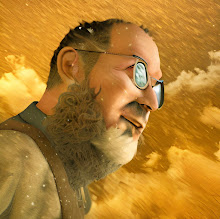
The image I created is a combination of the series poster and a picture I took of the Kurt Vonnegut, Jr. mural in Indianapolis that is titan-size.  I found it today going through some photos from 2021 and just realized the young figure of Erin Yeager could represent my son and KVJ looming over the wall is me as an elderly male.  From a developmental perspective it is like a metaphor of my son needing to grow and overcome my dominance/control in order to eventually take his place as an adult in society.

***

Thursday, June 29, 2023

KVJ Documentary


March 25, 2022


I just finished the Kurt Vonnegut documentary “Unstuck in Time” and, ho boy, it surely hit me in the feels.

I’ve been reading some of his novels the past few years to include re-reading Slaughterhouse Five as well as purchasing the graphic novel version at the Kurt Vonnegut Memorial Library gift shop when I visited there last year. It was my first visit to the new location in Indianapolis and because of the pandemic I was the only one there, having called ahead to set up an appointment of sorts. I was donating a copy of Life magazine from 1971 that I’d inherited from my Grandpa’s things and had a Vonnegut short story in it (Richard Nixon was on the cover, for goodness’ sake!). A Saturday morning tour of the museum followed while Elias slept in at our hotel room recovering from an AAU basketball game from the night before.

It seems a shame that I read so little of him prior to my 40’s, but there is much of his work that I would not have appreciated when I was younger. Now in my 50’s it is both painful and fascinating to see how similar our outlooks were/are when he was at this age. The realization kind of came full bloom as the documentary wound down and I realized his last published work before he died was a collection of essays entitled “Man Without a Country” which so strangely echoes things I have written about in my post-Army life, even just a week ago.

Probably the most Vonnegut-influenced thing I’ve ever written was Department of Dance which ends with a nod to Kurt and his famous bird’s call “Poo-tee-weet?” from Slaughterhouse Five that “symbolizes the lack of anything intelligent to say about war.“ Sadly, these are realities that continue to haunt us and I am thankful for Kurt’s unwavering honesty in writing about such things.

***

Wednesday, April 26, 2023

ARMAGEDDON IN RETROSPECT


I don’t know when Kurt Vonnegut wrote “Wailing Shall Be in All Streets” but it is his harrowing account of the bombing of Dresden as someone who was there and miraculously survived.  I did not know such a thing existed.  Like many, I assumed his statement on that matter was exclusively laid out by way of his brilliantly mad novel “Slaughterhouse-Five”.  But here is a short straightforward account that was previously unpublished in a collection of such writings put together in 2008 under the title “ARMAGEDDON IN RETROSPECT”.  


Speaking of SH-5, I find it fascinating that he chose to wrestle with such a horrific experience through a pseudo-science fiction novel that may or may not be science fiction, though it is certainly a mix of fiction and nonfiction.  He opened the door to others who may have had traumatic experiences that could not be approached head on but required some kind of back door or sideways approach to blunt the horror of the thing, like seeing a skilled psychoanalyst.  Or maybe it is simply a more effective way to explain the unexplainable.  I’ve read that Tim O’Brien cites SH-5 as an inspiration for his own wrestling with war experiences in a fiction-nonfiction hybrid.


I had my own moment as a medical officer deployed to Iraq that was a moral crisis of sorts and evaded processing for years until I finally found a way to get it out by way of a poem (and thanks to “So It Goes” journal for helping me share it with a wider audience).  It is not an easy or straightforward process and tends to be ineffective or fall flat if simply recorded in a journalistic style of facts following a rigid chronology.  


A friend of mine when I was in my twenties had experienced a traumatizing event as a Marine pilot-in-training when the jet he was training in crashed during take off and the pilot was killed.  He wrote a short novel to process his experiences surrounding the event using elements of magical realism and attempted to get it published.  He eventually self-published it and I bought a copy only to discover it was nearly unreadable in how poorly it was written and conceptualized.  But at the back of the book he provided a straight forward account of the accident much like Kurt did in “Wailing Shall Be in All Streets” and it was actually pretty good.  In retrospect I can only assume my friend took Slaughterhouse-Five as his inspiration, though few have the genius and persistence of a Kurt Vonnegut to pull it off.


Regardless, I think Kurt would have encouraged my friend, and myself for that matter, to keep writing and let some of that suppressed stuff burble to the surface where it can be recognized and handled (otherwise it has the potential to perpetrate mischief by creating traps and pitfalls that we continue to blindly fall into).  In this way it can be ARMAGEDDON, but truly in RETROSPECT.  


***


Thursday, November 17, 2022

Posthumous Letter to KVJ


Hello Kurt, you probably don’t remember me but we met at a high school somewhere in Indianapolis.  I was the teenager with a copy of Cat’s Cradle and a pen trying to get you to autograph it.  There was no Security present so my friends and I simply ambushed you at the back stage door.  You were smoking a cigarette (nothing you'd blink your eye at inside a building in the mid-80’s).  I wish I’d made a better impression.  You looked irritated.  I understand that now.  The cult of celebrity is a mixed blessing at best, a perpetual curse at worst.  


I remember it was a cold and wet evening in late Fall.  We drove up from Mitchell, Indiana.  The only thing I can still remember about your talk these 36 years later is that you were mad as hell at Ronald Reagan and his bombing of Libya.  At the time I was a Reagan fanboy and your words left me conflicted.  I understand it better now.  My “big brain” has processed quite a bit more information since then and I’ve had opportunity to travel the globe learning some humility and maybe even grace.  Blessings to you wherever you are [3 words here].


Aaron


***

Thursday, April 21, 2022

“Visual Writing” a la KVJ


When you seemingly run out of things to write about sometimes you end up writing about writing.


***


My recent explorations into the life and work of Kurt Vonnegut, Jr. (KVJ) have been uncovering some startling similarities in outlook and style that I was hitherto unaware of.  I am not saying I am in the same league as KVJ as a writer (Heavens, no!) but maybe he is a grown man and I am a kind of baby brother.  Maybe we share some DNA but I am significantly smaller in size and lacking in the ability to fully function as an adult (read: “write”) but I keep crawling nonetheless.


***


In continuing to read Suzanne McConnell’s “Pity the Reader: on writing with style” I stumbled upon something this morning that was revelatory.  She pointed out that KVJ would doodle during class at the Iowa Writer’s Workshop where she was a student of his.  This was connected to the fact his father and grandfather were architects, his sister was an artist, and his three children were all painters to some degree or other.  All this to say that “Vonnegut was tuned and trained to the visual, as well as the audial.”  This is followed by the key paragraph which is a KVJ quote:


“The people who were senior to me at the Sun [Cornell University’s newspaper] were full of advice. . . . The theory was that large, sprawling paragraphs tended to discourage readers and make the paper appear ugly.  Their strategy was primarily visual—that is, short paragraphs, often one-sentence paragraphs.  It seems to work very well, seemed to serve both me and the readers, so I stayed with it when I decided to make a living as a fiction writer.”


These ideas are revelatory to me because over the past 10 years that I’ve attempted to grow as a writer I’ve used photographs/creative images along with short almost poem-like paragraphs to convey what I want to convey to my (mostly imaginary) readers.  I keep these writings in my blog and you can scroll through hundreds of entries without finding one that lacks an image or has an unwieldy paragraph in it (never mind the preponderance of poems).  


I used to think this approach might be a crutch, but now that I’m reading this about KVJ I feel I can embrace it freely as my particular way of communicating what is inside me.  As an added bonus, the doodles I’ve made in countless classes and meetings over the years no longer need to be a source of shame or embarrassment. 


***


Maybe my job has something to do with it as well or there has been some cross-pollination going on.  I am a Consultation Liaison Psychiatrist at a hospital and I see patients who are primarily there for medical reasons but with a significant psychiatric overlap.  Other services consult me to have patients evaluated for a variety of reasons to include psychosis, mania, suicidality, delirium, dementia, withdrawal, depression, anxiety… and the list goes on.


It is important that my documentation is accessible and easily understood.  I accomplish this in part by utilizing short pithy paragraphs that are easy on the eyes and do not bog you down in a mass of words on the screen.  It is a common pitfall when I have medical students or residents working with me that they will try and submit a complex Borg-box of dense writing that no one will bother to read or if they have to read it they will become irritated in the process.  No one enjoys being forced to be “assimilated”.  


***


It is in this context that I can better understand what I’ve been trying to do with a peculiar structural style that began with a writing experiment from 2016.  It started as a writing exercise where I was meandering with an idea but keeping all the paragraphs small and of uniform size, almost like a poem.  At some point I realized it was actually helpful in moving the story along and forcing me to be more deliberate in what I was trying to say and what images were being conveyed.  Instead of a diarrhea of words I was dropping rabbit pellets along a path to an ending.  


After I finished this first experiment (The Hovel) I assumed it was a one-off and just an exercise of sorts, but the second time I tried it the flow returned and carried me along in a way that was unlike the struggles of “free” writing.  And now I have about six or seven of these type stories in my blog.  They are visually peculiar, like bricks stacked one on top of the other.  Maybe this is not exactly what KVJ had in mind but I enjoy it and hopefully it can “serve both me and the readers” whomever they may be.  


Thursday, March 24, 2022

The Benefits of Writing


I’d like to put in a plug for writing.  It has been a lifesaver for me through some pretty dark times, especially in the past few years of this pandemic.  It’s been a way to connect with others in a world where isolation can be crushing.  In the past decade it has even been a dialogue through time and space between me and my younger self who exists only in memories but influences so much of what I say and do in the here and now.


Maybe the form of writing at hand is a poem because they are short and “easy”.  I didn’t say “good”, just easy in the sense they can be written down quickly and concisely.  I leave iambic pentameter and the outpouring of cantos to other more skilled practitioners.  And rhyming is fun, but I do not use it very often.  I mostly settle for micro-bits of emotion and glimmers of insight that pop out from time to time, like when heat transforms a kernel of corn into popcorn.  If I can capture these burst kernels on paper the benefits are more filling and longer lasting. 


Memories of younger years generate a fair amount of what I’ve written, but the other major source is photographs I’ve taken.  I highly recommend this strategy for generating words because for me it has inspired the lion’s share of what I have written in the past decade and been a well of ideas to draw from.  It is typically something peculiar that catches my eye and suggests a story of some kind, like a Rorschach test. 


I’ve also benefited from books that give advice and/or ideas for writing prompts.  These include “Writing Down the Bones” by Natalie Goldberg, “On Writing” by Stephen King, and “The Artist’s Way” by Julia Cameron among others.  I used these mostly in my early to mid-40’s when I was trying to get started writing before transitioning to using childhood memories and photographs as the major sources for inspiration and writing ideas.  And speaking of childhood, my kids have done their fair share of heavy lifting in regards to being my muses.


Most of the writing advice I’ve come across emphasizes the importance of reading and reading a lot.  This is especially true of Stephen King who follows his own advice and has written book reviews for books that I’ve ended up reading due to his enthusiasms.  I have to say I don’t read a lot nowadays but when I was a kid I read all the time to escape the mundaneness of small town life.  I had a penchant for Fantasy with Science Fiction as a close second (and then Roger Zelazny blew my mind by mixing the two).


Most recently I’ve gotten on a Kurt Vonnegut kick and I’m watching the documentary “Unstuck in Time” on Hulu.  I’m also reading “PITY THE READER - on writing with style” by Suzanne McConnell who uses KV as her touchstone for writing and writing advice.  I’ve learned a lot from his brevity of style that he attributes to his early writing years when he was doing a lot of journalistic work which requires one to get to the point quickly and distill things down to their essence as much as possible.  His literary journal “So It Goes” has become a home for some of my poems and photographs and something I look forward to submitting to every year.


All that to say, whatever your motivation or life experiences, writing may very well be the “easiest” and most accessible way of engaging in a therapeutic process.  I highly recommend it.


***

Wednesday, March 09, 2022

What Kurt has to Say


Is there a more clear-sighted observer of our modern American experience than Kurt Vonnegut, Jr.?  That is a rhetorical question.


I couldn’t tolerate his stories when I was younger because I was trapped in the warm delusional embrace of the insulated American Midwest.  When it came to our historical and national consciousness it was all a Ra Ra self-congratulatory affair with flags flapping from poles and porches throughout my town.   It didn’t help that the Soviet Union was such a monstrous system as a point of comparison on the other side of the world.  We were pretty darn good in that light, right?  But we were human beings just like everyone else on the planet with similar foibles and outright repugnant behaviors mixed in with moments of selflessness and virtue.  


Our black and white way of seeing things outwardly had a tendency to turn inwardly creating a bind.  If we personally were either black or white, who can tolerate thinking of themselves as black?  So that left being white and therefore in a state of self-delusion and denial as a way to square that circle.  I’ll leave the implications for racism to your imagination as just one aspect of that phenomenon.


And KVJ ruthlessly destroyed all of this in his short stories and novels in the most humorous of ways.  He was honest enough about his approach to quote a British critic “who said that I put bitter coatings on sugar pills, and I consider that fair”.  His witnessing of the utter destruction and decimation of Dresden by the Allied Powers was the purifying event that opened his eyes, traumatic as it was, like a huge slap in the face.  Wake up!  


I was probably in my thirties before I had an “ear to hear” what KVJ was telling me.  It took at least a decade post-high school with stints in the Army, living overseas, medical school, and changing my childhood religion to open my eyes to what he had to show me.  Suffering was a key teacher in that regard.  I had to get past myself and the need for self-justification.  


And now I must circle back to the idea of "love of country".  I love my friends, family, and community as concrete points of interaction.  This is my “USA”.  What I don’t love so much are the abstractions created by the powers that be to manipulate me for their own purposes.  


And Kurt, God bless him, asserted in Breakfast of Champions that “at the core of each person who reads this book is a band of unwavering light.”  I believe it is a light that dispels the darkness of hatred and ignorance if we let it.


***

Friday, October 01, 2021

Galápagos


(or “A Spoonful of Sugar”)


Can you say “Galápagos”

with the proper accent?

It is quite rewarding.

You should try it.

It’s almost as much fun 

as saying the alliterative

“blue-footed booby” which 

is sillier though less exotic.


Calling Kurt Vonnegut silly 

would be silly or at 

the very least misguided.


He is definitely funny

but in most cases he is 

serious as a heart attack

and a stopped heart

is no laughing matter.

Unless you’re laughing 

yourself to death and

that death is your ego or

sense of self-importance.


***

Thursday, July 18, 2019

Pretty Things


“Billy stayed in the wagon when it reached the slaughterhouse, sunning himself.  The others went looking for souvenirs.  Later on in life, the Tralfamadorians would advise Billy to concentrate on the happy moments of his life, and to ignore the unhappy ones —to stare only at pretty things as eternity failed to go by.  If this sort of selectivity had been possible for Billy, he might have chosen as his happiest moment his sun-drenched snooze in the back of the wagon.”     

Slaughterhouse-Five

____


Reading this paragraph in Vonnegut’s novel triggered thoughts of what such a moment might be for me in my past.  The image that came to mind was a brief moment in my undergraduate days at Indiana Wesleyan in either 1989 or 1990 before I’d dropped out to join the Army.

I was walking on a sidewalk heading East towards our campus dining facility on an exceedingly pleasant and sunny day.  I passed under the shade of a large tree that is not there anymore and when I reemerged into the sun it triggered an intense feeling that Vonnegut would famously describe as “Everything was beautiful, and nothing hurt” in an epitaph.

It was startling, really.  I had had so many misadventures and misfirings up to that point post-high school, feeling  listless and directionless, until that very moment when everything seemed right with the universe.  I became emotional and felt tears starting to well up in my eyes.

It was pure delusion of course.  Most likely a dopamine dump  that had flooded my synapses, but a moment nonetheless that gives one hope to keep going and see what’s around the next bend.  Maybe it’s an unforeseen blessing or maybe it’s more misery.  The important thing is that there are possibilities (forget probabilities) and opportunities that float there in the not-yet.


***

Tuesday, June 25, 2019

Unstuck in Time


Aaron has come unstuck in time, much like Billy Pilgrim at the beginning of chapter two in Slaughterhouse-Five.  There’s a kind of snipping sensation when his eyes lose focus and take a rest so that his internal vision can take over the controls.  Don’t try to talk to him when this happens.  You will be just some disembodied voice, like a medium from another plane of existence trying to break through.  He can, and likely will, ignore you.

It is the act of writing that he is experiencing.  The trigger is more often than not a particular memory or, more accurately, the *feeling* of a memory that begs to be re-felt and, in the re-feeling, shared with people who might want to read about such things so they can feel it too.  It is a reflection of our shared experience of the world.  We are all connected, so they say.

Check his backlog.  For some reason a crow is a recurring feature in these stories, especially the ones that reach back into his childhood.  Aaron is not sure why this must necessarily be the case but it seems unavoidable or even inevitable as a stand-in for himself or other key players.  Maybe it’s a symbol for something mysterious or inexplicable, like “all people are connected.”  His favorite, though the title might be a bit too on the nose, is “The Crow.”  That one is a doozy and really happened to his younger self.

What has sparked these thoughts as of today?  Well, for one, he is re-reading Vonnegut’s Slaughterhouse-Five due to this year being the 50th anniversary of its publication.  He just so happens to be 50 years old himself and is at this very moment writing in 3rd person in case you were wondering.

And something that happened yesterday as well...  Aaron becomes unstuck in time, but only by one day in order to share something strange that happened that is destined to be a felt memory.  His son has gone to the neighborhood Rec Center to play basketball and upon his return the 14 year old boy is obviously upset about something.  He comes into the kitchen and plops down on a stool and hits his not-quite-adult-sized fist onto the table.  

“What’s wrong, buddy?”  Aaron asks, speaking as his father.

“Nothing.”

They go back and forth with no information being exchanged until Aaron takes a stab at guessing what might be wrong to try and break the fruitless cycle.

“OK, I think you are angry at yourself because you saw an old lady stumble and fall at the Rec Center and you walked away and did nothing.”

The son stops staring into space and focuses on his father with a quizzical look.

“Am I right?”  Which is the only thing Aaron can say in response to such a look because he was not expecting it.

“Dad, I was walking home and I saw an old man fall out of his wheelchair in his driveway and he was saying ‘help, somebody help.’  I didn’t know what to do.  I saw a woman come over and she called 911 on her phone but I just kept walking.  I’m so mad at myself.  Why didn’t I stop and help?”

Aaron assures him that feeling upset at himself is a good thing and a sign that he cares about other people but that there was nothing to be done apart from that woman calling 911.  What the father is really thinking as these reassuring words are coming from his mouth is, “How in the sam hill was I able to interpret my son’s emotions so accurately without knowledge of what had actually happened?!”  He suspects time travel.


***

Friday, May 13, 2016

Vonnegut's House

Not too long ago a story popped up on my Facebook newsfeed which noted that Kurt Vonnegut's boyhood home in Indianapolis was up for sale.  It struck me as odd that the city had not purchased it and made it into a national monument of some sort or a tourable pilgrimage site for us Hoosier ex-pats.

I then began fantasizing about buying it and sharing the space previously occupied by this man I hold in such high regard.  Maybe I would brush past his ghostly form on the way to the bathroom in the middle of the night, tendrils of smoke lifting from his transparent cigarette.  Possession would not be an altogether unpleasant experience if my writing improved, though the nicotine cravings would likely be insufferable.

So the logistics of such a thing... I don't make enough money to purchase such a house.  This is something that could probably be remedied by a boost in ambition and time spent working.  It would also likely include my wife working as well.  But then I read this today from his collection of essays "Wampeters, Foma, & Grandfalloons (OPINIONS)" while sitting in the Columbus airport:

There is an almost intolerable sentimentality beneath everything I write.  British critics complain about it.  And Robert Scholes, the American critic, once said I put bitter coatings on sugar pills.
It's too late to change now.  At least I am aware of my origins---in a big, brick dreamhouse designed by my architect father, where nobody was home for long periods of time, except for me and Ida Young.

Just prior to that he writes about this black woman, Ida Young, who was the cook for his family and whom he spent most of his growing up years with.  He describes her thus:

Her name was Ida Young, and I probably spent more time with her than I spent with anybody---until I got married, of course.  She knew the Bible by heart, and she found plenty of comfort and wisdom in there.  She knew a lot of American history too---things she and other black people had seen and marveled at, and remembered and still talked about, in Indiana and Illinois and Ohio---and Kentucky and Tennessee.  She would read to me, too, from an anthology of sentimental poetry about love which would not die, about faithful dogs and humble cottages where happiness was, about people growing old, about visits to cemeteries, about babies who died.  I remember the name of the book, and I wish I had a copy, since it has so much to do with what I am.

My fantasy was dismantled by this telling excerpt describing his life in a practically parentless house.  I am incredibly lucky, dare I say 'blessed', that I can be home every day by dinner time and find my family there---my wife, son, daughter, dog, and fish.  Not to mention the squirrels, chipmunks, rabbits, and a nesting robin that live in our backyard.  As far as fantasies go, this is pretty darn fantastic.  And as a kind of consolation prize, we live in the house where central-Ohio-celebrity Flippo the Clown lived for forty years and built our lovely gazebo which he called his "gazooby."  God bless you, Flippo the Clown.  And God bless you, Kurt Vonnegut.

Monday, April 28, 2014

Being Kurt Vonnegut

Kurt Vonnegut Memorial Library

I don't know doodley squat and here is the proof.  We have been staying at the Resident's Inn on the canal in Indianapolis at least once a year for the past several years when we are in town.  We were there just last week for part of Elias's Spring Break, as a matter of fact.  On our first full day there we visited the zoo, took in the dolphin show, and drove around to other familiar places from when we used to live there before kids.  Upon our return to the hotel we swung into the back parking lot entrance off of Senate Avenue, but not before Jennifer said rather nonchalantly, "Hey, there's the Kurt Vonnegut Memorial Library."

"What did you say?" I asked, trying to keep the incredulity out of my voice.

"The window of the building we just passed read: Kurt Vonnegut Memorial Library."

It seemed too good to be true.  Really?  Something like that right under our noses and I never knew it was there?  I quickly parked and Elias and I ran across the parking lot, skipping around the corner acting silly.  And there it was!  I was positively giddy.  It seemed too much to hope that it would be open on a Saturday, but the door was unlocked and we stepped in expecting the unexpected, though in retrospect I do not know how unexpected it could have been considering the name of the place was pretty much self-explanatory.

An exceedingly pleasant lady greeted us and a quick glance around revealed we were the only ones there.  She explained what the museum was all about and showed us around the smallish interior that included multimedia presentations, artwork by Kurt, his typewriter that he used in the 70's (under glass), a life-sized replica of his writing study, and other paraphernalia associated with his life.  I shared with her that I was currently reading Breakfast of Champions which I thought was queer considering it had been many years since I'd last picked up any Vonnegut, though I had read a memoir by his son, Mark Vonnegut, a few years back.  His son is a pediatrician and suffers from Bipolar Disorder.  The book is "Just Like Someone Without Mental Illness Only More So", probably the most brilliant title I've ever come across, but I digress.

She shared about her connection to Kurt Vonnegut which was through her uncle who was Kurt's best friend and best man at his wedding.  I shared about my recent efforts at writing with an eventual goal of banging out a novel (likely after the kids have left home and arthritis has set in).  She persuaded me to sit in Kurt's chair in his replica room and I persuaded her to capture the moment with my phone.  I was hoping that his writerly blessing might fall on me in that moment as my posterior touched the padded vinyl seat and I leaned forward to place my fingers on the typewriter keys.

The next day we had some more downtime and Elias asked to return to the museum.  It was once again open and a younger man was now running the place.  He explained to us that the typewriter I'd posed with the day before was not only functional, but had paper in it for people to type whatever they'd like which would then be tweeted on their twitter, and so on and so forth.  I pulled up a Vonnegut-pertinent Facebook status on my phone that I'd posted only a week or two prior and clacked it onto the white paper, "Kurt Vonnegut has just revealed to me that I am an unwavering band of light and for that I am grateful."  It was a reference to something I'd read in Breakfast of Champions.  Elias was fascinated by the whole typewriter *clack-clack-clack-zing* thing.

Before we left the museum that final time I visited the small gift shop.  I wanted to purchase everything available to include a Kurt Vonnegut doll, but I didn't want to offend Kurt's spirit which had so sardonically skewered American consumerism, so I settled for a black baseball cap with the museum's logo on it.

Kurt Vonnegut Memorial Library


Kurt Vonnegut Memorial Library

Kurt Vonnegut Memorial Library


Kurt Vonnegut Memorial Library

Friday, January 31, 2014

Power Trio

Power Trio by []Aaroneous Monk[]
Power Trio, a photo by []Aaroneous Monk[] on Flickr.
Today I switched hospitals with a colleague for the convenience of going to a doctor's appointment that is located here. The thing I love most about this particular hospital is that it has a medical library that discards books relatively frequently and makes them available gratis. Many of the books are outdated manuals and reference books from obscure medical specialties, but sometimes, when the literary gods are feeling frisky, they are novels.

Today was just such a divinized day. The discard section was lined with brightly colored paperback spines that drew a running gaze from me, head tilted severely to the right. My eyes tripped along several low quality affairs and a shite-load of Tom Clancy titles until fixing firmly on the name Walker Percy. The book was "Love in the Ruins" and for those not familiar with mid-twentieth century Southern writers like Walker Percy, Eudora Welty or Flannery O'Connor, it might have been mistaken for a trashy romance or other some such thing. As it is, the main character is a psychiatrist and the story itself has a faint SciFi odor about it. It might as well have had my name written in it.

Another book that made my eyeballs stop and take notice was Kurt Vonnegut's "Breakfast of Champions". The last time I'd picked this book up and begun reading was in the early 90's as an overly earnest student at a stridently conservative college. Two chapters into it I had been thoroughly scandalized and saddened that this author whom I'd grown to love and trust for good fiction would write something so trashy and un-American. I stopped reading it in disgust and may have even thrown it away.

This book too was snatched up and put in my cargo pocket. I read the first two chapters while eating my lunch and found myself more than once giggling like a silly school girl. Such brilliant satire! Such scathingly accurate insights! Quirky as heck. Apparently it took twenty years of maturity for me to be able to appreciate what he was doing with this novel.

I met Kurt Vonnegut once, kind of, not really, and managed to piss him off. As a senior in High School I drove up to Indianapolis with some friends and fellow Vonnegut lovers on a blustery winter night to see him give a talk at a large High School auditorium. I had my hard back copy of Cat's Cradle with me and after the talk my friends and I snuck back stage.  As he attempted to exit in the rear I presented my book and a pen for his autograph while partially blocking the doorway. He gruffly waved me aside and pushed past us to leave, burning my friend's hand with his cigarette in the process. If I'd really known anything about him outside of the few books I'd read, I'd have probably known that that shite wouldn't fly with him. But I was just happy to have had my brush with fame, literally (literarally?).

The third book that caught my eye was John le Carré's "Russia House". To be perfectly honest, I have never read anything by him though I was enthralled by a movie based on one of his books, The Constant Gardner. I also recollect that the movie based on Russia House had a beautifully melancholic soundtrack that featured Branford Marsalis on soprano saxophone, a favorite Jazz musician of mine at the time. The music haunted me for weeks afterwards and gave me a burning desire to learn how to play a soprano saxophone.

I even went as far as to buy a soprano saxophone when I was living in Korea, a black beauty with nickel plated keys. I was able to shave almost two hundred dollars off of the price by using the monetary exchange rate to my advantage. The seller refused my offered price in dollars, so I split my offer into dollars and won (Korean currency) that he ended up accepting even though for me it was an equivalent amount. The one thing I learned from that experience is that if you want to learn how to play the saxophone, don't try and start with a soprano. And if you want a good deal in Korea, carry two currencies.

Sadly, I sold that saxophone a few years later for a loss in Bloomington Indiana after squeaking and squawking on it for awhile, but getting free books today has helped take away some of the lingering sting of that memory.