I'm driving home from work listening to Terry Gross interview singer-songwriter Mary Gauthier on the radio. She sings "Another Train" while playing her guitar and as the chorus glides in on a wave of melancholy, something magical happens in my car on this lonely Ohio road.
I'm surprised to hear my voice join in with a piercing tenor line that cuts through my heart like a honey-dipped knife. It's like some kind of spiritual harmonic has welded our voices together, resonating inwardly and outwardly, bigger and fuller than it should be considering I'm using a falsetto voice to catch those high notes.
It was my Dad who taught me this little bit of magic, the ability to hear the harmony lines to a song and add my voice to the weave. It started with him inviting me to sing with him in the church choir in my early teens, standing beside him as he pointed out the tenor line and I tried to follow his lead until I could do it on my own.
The other harmonic lines soon followed and I have added my voice to the likes of James Taylor, Neil Young, and Natalie Merchant, sometimes while washing the dishes and other times while driving my car. I can think of few things more precious that my Dad could have given me in this short life, certainly not monetary wealth or other coarse offerings, but the gift of joy in the making of music.
My son's closet is as big as it needs to be,
full of books, toys and misplaced articles of clothing.
If one were to clear a space to sit and ponder,
closing the door with an expectant push,
it would expand to encompass
all that is worthwhile in this short life.
The darkness, a comforting presence,
surrounded by familiar objects infused with joy and laughter.
Time would skip along the surface of fond memories,
then sink into something deeper still.
When I pass, time will no longer have a hold on me. My spirit will find this place, this circle of voices, inhabit it and be transported to where love is all in all. ***
It's the antithesis of a monastery,
assaulting the eyes and ears,
trying to draw me out, but instead
forcing me to retreat into myself.
The music pumping out of the
sunglasses store is so deafening that
customers must yell to be heard.
Adults are wearing mismatched
superhero costumes that a precocious
three year old could see through
while tourists and ticket sellers
pair off in a sidewalk pas de deux.
Broadway billboards boast of
being the best in some particularity:
longest running, newest, a Tony
for this and a Tony for that with
hyperbole from the New York Post.
The smell of honey-roasted nuts
mix with cigarette smoke and
the grilled meat of street vendors.
Sometimes I tire of driving this tank peering out of the periscope's finite field of vision turning this torso lifting these limbs these lead pipe legs trudging through too many muddy ruts seeking solid ground to gain traction to move forward through life's battles hoping to find a flowering field to rust in peace. ***
He sits with his back to me,
blue jacketed and tieless,
likely in his mid to upper fifties.
I see his face because of the
mirror at the back of the bar.
I can't help but notice how
slowly and deliberately he
reaches for his glass of beer,
as if he could miss it if he
is not careful and reach
past to where it is not. He
stares too long in the mirror.
He closes his eyes but a
slight wobble pops them open.
It's afternoon at an Irish Pub
in Midtown Manhattan.
The F train wasn't running
due to a malfunction
and New Yorkers knew to
find a different mode
of transportation this
particular Sunday morning.
I am not a New Yorker
and the F train was my
only route to Liturgy on
the Lower East Side.
I stood by the tracks
at the 42nd street station
oblivious of my ignorance.
After 10 minutes the train
arrived and I boarded
without qualm or incident.
Emerging at 2nd Avenue
a man quickly bore down
on me to ask if the F train
was, in fact, running now.
I assured him that it carried
me to where we now stood.
After Liturgy the priest said
that many were missing
because the F train did not
get running until after 10am.
Having arrived at 8:45am
I couldn't help but think,
"What the F?"
The Vikings came, but by invitation. The peoples of what is now Northern Russian
needed assistance to bring order from chaos and turned to their Nordic
neighbors for help. The ancient
crumbling fortress of Izborsk stands as testament to that dark time. It sits on a flat hilltop overlooking a long
valley that runs into a lake fed by twelve springs that pour out of the side of
a hill like mortal wounds.
My time at Izborsk was part of a day trip from the Pskov Caves
Holy Dormition Monastery where I'd been staying with my three traveling
companions. We had arrived by bus over
roads that nearly jarred the teeth out of my head: three Russian seminarians, a
monk novice, and me, a lost American.
Just inside the gaping hole that used to be the main gate sat a small
Orthodox church with a graveyard. The
tombstones had distinctive Scandinavian
shapes, darkened and worn by
centuries of weather. A nun carrying a
basket of blackberries greeted us with a lovely smile, her face peeking through
the opening of a once black head covering that had faded to gray.
We dropped our backpacks in a simple one room house that she made
available to us. A thick blackberry preserve was offered and
shared amongst us five weary pilgrims.
The sweet sticky mash renewed our vigor and brightened our spirits. In the midst of our simple feast, one of our
company suddenly jumped back in surprise and pointed at his backpack lying on
the floor. It was moving! He poked at it with a stick as we all held
our breath waiting to see what would happen next. A curious kitten stuck its head out of the
open flap and laughter poured out of us like soda from a shaken bottle.
We then took a long hike down to the lake to see the "Spring
of the Twelve Apostles" and passed through a large forested cemetery
outside of the fortress walls. At
the entrance was a large flat-topped boulder with three concentric squares chiseled
into its top. I was following the lines
and intersections with my finger while sitting on the boulder when an epiphany
struck. I knew what this strange
configuration was! I called my Russian
friends over to see what I'd discovered.
I explained to them that it was an ancient Viking game known in
England as "Nine Men's Morris", a game mentioned in one of
Shakespeare's plays. They were dully
impressed. I knew of it from a program I had on my computer called "Games
of the World" that included the Chinese game Go and the African game
Mancala along with Nine Men's Morris.
Each game was prefaced by a multimedia history lesson that explained the
game's origins. I remembered it showing
a photo of an excavated Viking ship that had been found with a Nine Men's
Morris board carved into its deck. And
here in Northern Russia I'd found one on the top of a rock.
We continued on through the countryside until stopping at a spring bubbling up into a small pool under a tree. We knelt and drank some of the water, water that
was so cold it was like a slap in the face.
My seminarian friend informed me that this was a blessed spring, famous
for curing those with maladies of the eye.
I immediately thought of my friend back home, Kevin, who suffered from
poor vision due to having had retina blastoma as a child. I felt compelled to get some of this water to
him but was unsure of how to do it. I
asked the others if they had water bottles, but no one did. They found a nearby farmer's house and
explained the situation to the man living there. He disappeared into his house and came out a
few minutes later with a glass bottle and a cork.
The day was spent like that, exploring this obscure part of
Russia with deep roots and great beauty.
The memories are only fragments now as they happened fifteen years ago
over a twelve hour period and I am only just now writing them down.
I don't know doodley squat and here is the proof. We have been staying at the Resident's Inn on the canal in Indianapolis at least once a year for the past several years when we are in town. We were there just last week for part of Elias's Spring Break, as a matter of fact. On our first full day there we visited the zoo, took in the dolphin show, and drove around to other familiar places from when we used to live there before kids. Upon our return to the hotel we swung into the back parking lot entrance off of Senate Avenue, but not before Jennifer said rather nonchalantly, "Hey, there's the Kurt Vonnegut Memorial Library."
"What did you say?" I asked, trying to keep the incredulity out of my voice.
"The window of the building we just passed read: Kurt Vonnegut Memorial Library."
It seemed too good to be true. Really? Something like that right under our noses and I never knew it was there? I quickly parked and Elias and I ran across the parking lot, skipping around the corner acting silly. And there it was! I was positively giddy. It seemed too much to hope that it would be open on a Saturday, but the door was unlocked and we stepped in expecting the unexpected, though in retrospect I do not know how unexpected it could have been considering the name of the place was pretty much self-explanatory.
An exceedingly pleasant lady greeted us and a quick glance around revealed we were the only ones there. She explained what the museum was all about and showed us around the smallish interior that included multimedia presentations, artwork by Kurt, his typewriter that he used in the 70's (under glass), a life-sized replica of his writing study, and other paraphernalia associated with his life. I shared with her that I was currently reading Breakfast of Champions which I thought was queer considering it had been many years since I'd last picked up any Vonnegut, though I had read a memoir by his son, Mark Vonnegut, a few years back. His son is a pediatrician and suffers from Bipolar Disorder. The book is "Just Like Someone Without Mental Illness Only More So", probably the most brilliant title I've ever come across, but I digress.
She shared about her connection to Kurt Vonnegut which was through her uncle who was Kurt's best friend and best man at his wedding. I shared about my recent efforts at writing with an eventual goal of banging out a novel (likely after the kids have left home and arthritis has set in). She persuaded me to sit in Kurt's chair in his replica room and I persuaded her to capture the moment with my phone. I was hoping that his writerly blessing might fall on me in that moment as my posterior touched the padded vinyl seat and I leaned forward to place my fingers on the typewriter keys.
The next day we had some more downtime and Elias asked to return to the museum. It was once again open and a younger man was now running the place. He explained to us that the typewriter I'd posed with the day before was not only functional, but had paper in it for people to type whatever they'd like which would then be tweeted on their twitter, and so on and so forth. I pulled up a Vonnegut-pertinent Facebook status on my phone that I'd posted only a week or two prior and clacked it onto the white paper, "Kurt Vonnegut has just revealed to me that I am an unwavering band of light and for that I am grateful." It was a reference to something I'd read in Breakfast of Champions. Elias was fascinated by the whole typewriter *clack-clack-clack-zing* thing.
Before we left the museum that final time I visited the small gift shop. I wanted to purchase everything available to include a Kurt Vonnegut doll, but I didn't want to offend Kurt's spirit which had so sardonically skewered American consumerism, so I settled for a black baseball cap with the museum's logo on it.
For twenty seven years, since the age of eighteen, I have been walking along, not looking back, in order to deal with a certain amount of instability, knowing I will not be staying put for long. I have now been living in one place for five years this Spring, which is the longest I've lived anywhere since I left home for college.
I am writing now and it is as if I've finally found the courage to look back, from a more stable place, a slightly higher place, that allows me to see much of what has come before. It is a wildly varied terrain with little continuity, though I believe there is a unifying force holding it together, maybe the sky above or some deep underground river.
It seems that I have lived long enough to finally be able to see these things and how they relate to who I am. My traveling companion of fifteen years has been an invaluable part of this process. Like a powerful magnifying lens, she has helped bring difficult things into focus. Some glimpses give weight to wonder while others fill me with a kind of dismal despair.
But if I can begin to try and make sense of it all, maybe I can change the terrain that is to come, making it something better, something higher, something deeper, something richer and more full of life as a lead-in to the world to come.
It's a white balloon that floats from place to place through time and space. The string remains firmly tied to my corporeal self, but my memory goes where it will, buoyed by the lightness of immaterial thoughts. At present there is a name scrawled in blue marker on the balloon, "Angela." She is my older sister by two years, two years that might as well have been twenty years in terms of maturity when we were growing up. The balloon with her name on it descends on a hospital in Southern Indiana and winds its way through well lit corridors to find a particular exam room. A doctor is entering that room and the balloon bobs down under the door frame brushing his crew cut as he shuts the door behind him.
She is twelve, maybe thirteen, wearing pants and a hospital gown partially open in the back. I am ten, maybe eleven, and I am there with her and my mother listening to the doctor explain what concerns him. He has my sister bend over while standing so that her arms dangle below her. The gown is tied at the bottom and her bare back rounds up out of it like a smooth-shelled sea turtle. It makes me a little uncomfortable, but things like this are possible in a doctor's office where body parts take on a peculiar significance.
He uncaps a blue ink pen and does something remarkable. Starting at her neck he draws a line on her skin straight down her spine, only it doesn't quite work out that way. Somewhere around the top of her shoulder blades the pen travels out and away from the center a good little ways before eventually making its way back to center, crossing the line again slightly, and then back to the middle. It is a visible gesture so that even I understand that something is not as it should be. As it soaks in, the friction that exists between the siblings doesn't seem quite so tangible as it did just a moment ago. The balloon floats out through an open window and heads South, forward into the future a bit, drawn on by a stream of thoughts and emotions.
She has moved on to Louisville, an hour or two from home, to stay at Kosair Children's hospital, by herself, off and on for weeks at a time, for an entire year. It is an old and sprawling building, built at a time when some thought was given to aesthetics and not just pure practicality. From a ten year old's perspective it appears to be a giant castle with wide verandas, stonework, wooden beams, and sharply angled eaves. As an adult I would recognize it as resembling a very large Swiss chalet. The front grounds are expanses of grass dotted with towering trees. I flew a kite on those lawns, played tag, and even set off fireworks with a cousin who came along with us on the Fourth of July that year. I see myself crawl under a pine tree and hide on a soft bed of needles.
The balloon floats through the front doors and bounces along the high ceilings. Below are children wearing contraptions on their arms, legs, or torsos, some shuffling along with the help of crutches and others in wheelchairs. It is a place unto itself, where things have gone terribly wrong and need to be made right. The balloon finds my sister lying in a hospital bed rigged up to what appears to be some kind of medieval torture device. Surrounding her ankles are leather straps connected to a pulley at the foot of the bed off of which hang weights dangling in space. Around her head and under her chin are more leather straps connected to more weights hanging off the back of the bed. She is being stretched, a week at a time, and body-casted intermittently throughout the course of a year.
When she is able to be free of these constraints she joins us on a second story veranda where I see myself running with a large soap-saturated ring making elongated bubbles. The balloon enters the ring and makes its way down the bubble's interior. Floating down this thin walled tube it passes my father, my mother, my four year old sister, and Angela, all comically distorted through the warped surface. I feel it pop and watch tiny droplets spatter over my freckled face.
She has a roommate named Wendy, like in Peter Pan. They pass the time sharing stories while staring at the ceiling, strapped as they are, only able to see the other through the corner of the eye. Their chins are always chafed and red from the pressure of the straps. These markings leave my young self with a sense of disquiet tinged with awe. It is a concrete sign of what my immature brain cannot really even imagine and makes me shudder even now thinking about it. The balloon hovers over Wendy's bed as she is telling a story, a story of when Baryshnikov was in Louisville for a performance and she acquired a beer bottle that he'd drunk from, fished from a trashcan if I remember correctly. She treasured it as a sacred souvenir, having touched the lips of one of the greatest ballet dancers of all time. She herself went on to become one of the greats in dance, this preadolescent girl who is better known today as the recently retired Wendy Whelan.
The balloon floats forward in time to a scene in my early married years as a Medical Student before kids have come into the picture. My young wife and I are watching a program on PBS. I am intrigued because it includes jazz trumpeter Wynton Marsalis in the process of creating music in collaboration with a choreographer. I am a lover of jazz music; my Father and I both played trumpet. My wife is intrigued with the dancer because she had danced when she was younger and knew this particular ballerina from the dance magazines she had consumed as a teenager. The dancer on the TV screen with Wynton Marsalis is Wendy, though I don't make the connection until some time later.
Time flashes forward again and now I see myself as a young psychiatrist at a conference in downtown Louisville. Nearby is Kosair Children's Hospital and out of curiosity I wander down the street and into the front lobby. It has long since moved out of its old building on the outskirts of town and instead inhabits this glass and steel structure amongst other glass and steel structures. Inside there are brightly colored banners and large stuffed animals to make it more child friendly. The balloon fits right in, but there is not a single blade of grass or even a solitary tree here. Practicality has won out. This is a place to fix the human machine, a realization that makes me feel blue.
The balloon labeled "Angela" finds its way back to me sitting here at the dining room table typing these words, back curved over the keyboard, touched by what I've seen, finding it hard to believe I was ever the age my son is now or that my sister had to go through such a thing as a young girl. Life threw her a curve, as it were. I should call her.
The giant hand
gestures at
the homeless man
as if to say,
"See there,
a person in despair,
who must firmly grasp
his shoe straps and
hoist himself
into the air."
He is unaware
of the hovering attention,
the condescension.
The "invisible hand"
offers little
in the way
of a plan
that he can follow
or understand.
She pulls away
as if to say,
"You are not worth
the time of day"
and shoves up
her sleeves
to do nothing.
*** left foot forward right to the rear a quick counter-clockwise spin of the torso arms flung outward holding the hips still as long as possible until the tension is too great and the right foot lifts from the ground whipped around in an arc of unwinding energy until meeting a piece of piano with an abrupt halt and the failure of vascular integrity accompanied by a rush of pain ***
My son is asleep in his bed
and he is beautiful.
He sleeps soundly,
at peace,
because love
tucked him in.
Watching him breathe,
my mind winds its way
back to a troubling past,
the days before I was married
and had little thought
for my own safety.
Seeing him lying there,
his life dependent on mine
both now and in the days
prior to his birth
for the sake
of what was to come,
I shudder in thinking
of the numberless times
I put myself in danger,
without a care,
on some adventure,
giving my physical wellbeing
over to chance,
whether here or overseas,
with friends or alone,
and I feel like an utter fool.
Somewhere
in the back of his muddled brain he seemed to recollect he'd been a medical
student once, before the cognitive decline, the skin problems and the muscle
stiffness. When he could still put more than a few thoughts together he had
speculated that he must have come into contact with some exotic disease in the
tertiary care hospital on campus. He should have sought medical attention at
the first sign of symptoms, but he was someone who kept to himself, always in fear
of being called out or considered a slacker. He was not one to self-diagnose
like many of his classmates who were eager to utilize their newly acquired
knowledge. He made do even as his grades plummeted and he began to sneak into
the gross anatomy lab late at night for a little snack.
There was a time when the idea of eating brains would have greatly disturbed
him, he was not ignorant of the risk of prion disease after all, but that was
before the hunger began. He'd been studying in the medical library one Fall
evening (a futile endeavor as he could retain little) when a picture of a brain
in his anatomy text triggered a growl in his midsection. This was quickly
followed by the thought that the anatomy lab was only one floor above him and
maybe he would just put in a little time working on his cadaver. The books were
doing him no good, so why not some hands-on work?
He put his books away and shuffled through the door and into the darkened
hallway. He held his arms out in front of him because it felt right somehow,
though he told himself it was just to feel his way through the dark. The
elevator was an old fashioned affair that could only hold a few people with a
metal-cage door that folded to one side with a tug. He stepped into the center
under the sickly hue of the single light that cast shadows over his eyes.
He turned awkwardly then pulled the cage door shut. The elevator
jerked and rattled upward. A blank stare mirrored a growing single mindedness.
Standing over his assigned cadaver he clicked on the low hanging fluorescent
light above his head illuminating the dissecting table. His eyes kept wandering
up to the head before he forced them back down to the dissected abdomen. The
brain dissection was not for a few more weeks into the curriculum, but his own
pre-frontal cortex appeared to be misfiring. An impulse had him reaching for
the bone saw and plugging it in. A flick of the switch and its half-circled
cutting blade buzzed to life with a kick in his hand. He found himself
breathing quicker as he applied it to the forehead and pressed downward. Flecks
of skin and small bone chips began flying off into the darkness of the room.
It took some doing, but with the help of a small crowbar-type tool he was able
to eventually pry off the top of the cranium as the arachnoid mater separated in web-like strands. He paused and took in the sight: a shiny grayish
beige surface of what appeared to be intertwined sausages. A pleasurable
shudder shot through his body. It was a welcome sensation after what had been a
growing sense of numbness over the past few weeks. He pushed down on it and it
pushed back with a kind of rubbery resistance. He pushed harder and his finger
broke through the surface, buried to the second knuckle. He retrieved his
finger and placed it into his mouth. It was a little bland, but not too bad.
The next few days he noticed that he had little appetite for his normal fare
and was not visiting the cafeteria or making his typical late night Taco Bell
runs. His thoughts kept returning to the anatomy lab where he'd made a few more
trips taking thin slices of the brain before carefully replacing the top of the
cranium. He'd discovered that the slices tasted even better when laid on a Ritz
cracker, yet something was missing. This was quickly becoming his sole source
of nourishment and he was growing paler by the day, preferring to come out only
in the evening hours. He also began staying in his apartment less and less,
hanging out instead behind an abandoned dumpster in a back alley that he could
crawl into for shelter when needed.
His clothes were getting a bit raggedy and hung loosely on him. He couldn't
remember the last time he'd changed them and he didn't seem to care. His main
preoccupation had become one of trying to figure out how to get fresh brains
which he was sure were much tastier than the formaldehyde scented slices he'd
come to depend on. Before he'd descended into what appeared to be a premature
dementia, he'd had the wherewithal to put the bone saw in his backpack which he
kept behind the dumpster near a covered electrical outlet that was conveniently
located on the alley wall.
The days passed and the lonely former medical student became increasingly
depressed as his slow movements frustrated attempts to acquire what he needed
to feed his hunger. The occasional nighttime passerby easily eluded him. He was
dismissed as a mostly harmless and malodorous drunk by those who found their
way down his alley. This went on for quite a long time as technology and human
habits began to change, changes that resulted in an upturn of his fortunes.
He would never forget that first time (though it was quickly forgotten). She was likely a college student or may
have even been attending his former medical school. She was using the alley as
a short cut and was thoroughly engrossed with a glowing rectangle of some kind
in her hand. He watched from behind his dumpster in dumb amazement as she
approached, her face and blond hair cast in a bluish light from the thing that
she held. He stepped out and she almost walked straight into him as he closed his
hands around her throat to cut off her scream.
From that moment forward more and more distracted persons made their
acquaintance with his bone saw and ended up in his dumpster. He learned to use
their small devices by tapping them with his mottled finger until the batteries
were dead. He no longer had to feel the anguish of hunger and their glowing
boxes provided hours of mindless entertainment inside his darkened dumpster. He
did not seem capable of introspection, but he thought he might be happy.
Driving home
'round midnight
on High Street
steady rain falls
putting a thick
shine on every
conceivable surface
the lane lines
barely visible
floating sensation
like a small fish
skimming along
the back of a
Killer Whale
neon lights from
Tee Jaye's create
a psychedelic slick
on the street
colors running together
over the washed windshield
puddles sending out
splashes of synesthesia
NPR's "Echoes"
on the dial
ambient music of
Tangerine Dream
flowing from the radio
like liquid sound
a pseudo-experience of
sensory-altering substances
striking the cortex.
"People say I'm crazy, doin' what I'm doin'..." or so sings John Lennon, a man and his music that I've grown to appreciate over the years. This has been especially true after becoming a father myself and seeing the positive changes it made in his life after Sean came into the picture. It didn't hurt that in my college years I grew my hair long and wore circular spectacles for a time. Those were the days of the occasional comment that I resembled the former Beatle which helped solidify the affinity.
This phenomenon had its strangest manifestation when I was living in Korea. One of my friends during that time was a Korean man who went by the name "Paul". The first time I saw him was at Seoul Union Church, barefoot and sitting Indian-style on a side pew with his eyes closed. He wore all black and had a large wooden pectoral cross hung around his neck. We went out after the service to a coffee shop where I learned he was a Catholic attending a Protestant church because "I'm learning about all different kinds of spirituality." He was a peculiar fellow, fancied himself a monastic of some sort and never without a lit cigarette on his lips.
He had a part time job at a Catholic bookstore and was always broke, which he reframed as a monastic virtue. We spent most of our time together hanging out in coffee shops with me picking up the tab, but on one occasion he took a notion to treat me at a small restaurant near his neighborhood. He was very excited about this and ordered a good amount of food that I slurped down gladly. We were there for what seemed a very long time and the restaurant owner was becoming increasingly impatient, asking Paul if there was anything more we needed. Finally, he came clean with them that he had no money but assured them that he would return by week's end to cover the bill. What could they do but agree to this atypical arrangement? I did not have the money to cover the tab or I would have paid for the feast we'd just indulged in. This, as I was to learn, was par for the course when hanging out with Paul.
Another incident involved one of the ubiquitous coffee shops which cover Seoul like a pleasant rash. These establishments must top the list of Korea's entrepreneurial endeavors as there are so many unique offerings and so few chains. I must have visited at least a hundred of these places in multiple cities and towns. The one I'm thinking of was very dark with no windows and low lighting. Either side of the room had booths lining the walls and running down the center were tables and chairs separated by chest high wooden dividers for a sense of privacy. Paul was chain smoking as usual and complaining about his extreme sinus pain. He said that he needed just fifteen minutes to sleep and laid down in the booth with his dirty bare feet sticking out into the aisle. The female owner eventually saw this and came over to tell him he couldn't sleep here. She looked very stern with hands on hips, but I held up my hand to keep her from shaking him and told her in Korean to please not do that, he was not feeling well. A waitress had come over by that time to see what was going on. The owner's stern look broke at my attempt to intervene with minimal Korean language skills and she gave a little forced laugh. She then directed the waitress to help her move one of the wooden divider walls and they placed it in front of our booth so that people couldn't see Paul sleeping there like a homeless person from the street.
He had a way of exasperating people who weren't in tune with his oddness. It definitely made things interesting.
After being in Korea for two years, my tour of duty with the Army was up and I returned to the States to finish my senior year of college. That last year at Indiana Wesleyan University I befriended the six or so Korean students there and when I returned to Korea as a civilian I met up with two of them at different times to hang out, one in Seoul and one in Pusan. I met the one from Seoul, whom I'll call "Ki" because that is the half of his name that I still remember, at one of the many coffee shops I'd frequented during my two previous years there. We were sitting at a window booth on the second floor overlooking the front of the building.
By that time I'd grown my hair down to my shoulders and carried with me some retro green tinted sunglasses, very different from my military cut and look of the previous year. Ki and I were reminiscing about the good times we'd had the past year at IWU when I glanced out of the window and saw a man staring up at me from the street, fixed in place, eyes big as saucers. It was Paul. He broke into a huge grin and started waving frantically. My Korean friend looked at him and then looked at me with a distinct WTF? expression. As Paul hurried to the front door I quickly explained to Ki that I knew Paul from when I was last in Korea and that he was a little strange, trying to prepare him for what was to come.
Paul barreled up the steps and plopped onto the bench opposite me next to Ki. He was like a kid hopped up on sugar. Ki was bemused but also visibly uncomfortable with Paul's demeanor. I should add here that Ki was a "cool guy" who used expensive haircare products and wore fashionable clothes. Paul prattled on in a rapid fire manner and then, rather excitedly, declared that I looked exactly like John Lennon. He wanted me to put on my sunglasses and would not take "no" for an answer. I finally relented and as soon as they settled on my nose Paul exploded into squeals and clapping, "IT'S JOHN LENNON! IT'S JOHN LENNON! WOO WOO! YOU ARE FAMOUS! YOU ARE FAMOUS!" Ki looked like he wanted to slide under the table and hide from all of the eyes that were suddenly drawn to our table. I quickly removed the sunglasses but it was too late. Ki was caught in a seriously uncool scene and I felt bad for him, but I couldn't bring myself to be mad at Paul. No one had expected such a highly improbable meeting. Maybe it was just meant to be.
So, fast forward twenty years to last night. I was feeding Poppyseed her bedtime snack at the dining room table. She typically will refuse to eat any bites unless there is something that interests her playing on the iPhone. A friend had posted a link to John Lennon's "Watching the Wheels" on Facebook earlier in the day and so I pulled it up for her. The video included pictures of John in various poses and situations as well as some live action stuff, some with a beard and some without, some with long hair and some without, some with glasses and some without. Poppyseed leaned forward to get a closer look and said very matter-of-factly "Dat's you." She said it again while pointing at a picture of John with medium length hair poking out from under a beret, glasses and no beard, "Dat's you, Daddy." She looked up at me with a funny little smile as I watched the wheels go round and round in her bright eyes.
***
I ask forgiveness
for everything
and from everyone
without exception
because the only
evil that matters
is that which
I've contributed
to the noxious mix
of self-centered
wants and desires
that do not
recognize limits
or restraint
where mediocrity
masks as virtue
and suffering multiplies
with my indifference
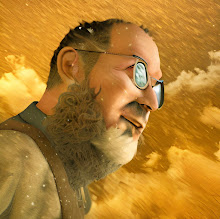
“Aaroneous Monk” brings to mind the image of a bumbling but well-meaning hermit who continually trips himself up in his overgrown beard as he attempts to battle evil in the world but, more often than not, forgets about the darkness in his own heart.
It also sounds similar to the legendary jazz pianist Thelonious Monk, but with a faux-Greek twist. Thelonious was known for being able to maintain two disparate rhythms going at the same time with his hands seemingly disconnected from each other. That kinda sums up my struggle...


.JPG)




!["WHAT'S YOUR INTERPRETATION?" by []Aaroneous Monk[]](https://lh3.googleusercontent.com/blogger_img_proxy/AEn0k_u6Usd5O3ryCL8NM8bClcqjvsRi16cwaIAJqRIyIQ-rkVW06WW1wsISiOKdowxuXulqLCJvDjFckGm4veFI2qLD3Dpy9bLCf6-5z-sW3KqUXQQHQHEPE-9ZUtiB3bJ9=s0-d)
![Purple Foot by []Aaroneous Monk[]](https://lh3.googleusercontent.com/blogger_img_proxy/AEn0k_uuj7WZqKGGegO3dPNvVhnbqB6yhnAE2xoK3DG9dl26eO8lMdV6HqqeA7fdQqGeL_m_ypPKpSmXcpJl0B2ZlyEIC-5bLcPOMplcnj5ySie5hR8CC5F0Wa2Avxcv0M7rIu8=s0-d)
![The Brothers K by []Aaroneous Monk[]](https://lh3.googleusercontent.com/blogger_img_proxy/AEn0k_sFmVfgVRGb_N-BPVqQNnht-_9FqLxwus6X01fz2u0WKnq6_Kchll7dm6Qi3psPp7PlzpGRLR2ND7g6Y_Uk8t_2oebJ53YjzHocDXFfYN-7jh1NzYsBzSdw0vI0-uKNWLc=s0-d)
![[]Aaroneous Monk[]'s items](https://lh3.googleusercontent.com/blogger_img_proxy/AEn0k_tbdQq3WvxExing6w4F7q7wSRZm9o15FIgrPt6gl4HkGyju7WdHyrVtwE7TANOojotmiN3sX1-VOGvvCTrpXUOZZi9jJqhi51QgtDbPxS2LQ9PsqTLE7DEqzx-IMLP6bOWAJOQae_pRkytGcGtn1e6-JAWKue_Meg=s0-d)